Global warming is now all but universally accepted by scientists, and even the public is starting to (slowly) come around to recognizing the crisis. While many big corporations are spending millions of dollars denying climate change, trying to protect their profits from regulations that might limit their emissions, their efforts have not been entirely successful. Extremist right-wing groups are trying to convince Americans that climate change is a scientific conspiracy trying to force people into accepting a "green lifestyle". While this claim doesn't make a lot of sense, it still has a decent acceptance rate.
While scientists and environmentalists are begging people to take a stand against climate change and adopt a sustainable lifestyle, it would look like people aren't yet doing enough. Global carbon dioxide emission levels this year increased 2.6% from last year, and 58% over 1900 levels. While this is below the average increase since 2000, it is still considerably above the annual increase in the 1980s and 1990s. Due to the rapid increase, scientists are now predicting that their earlier estimate of a 2C global temperature rise may have been too optimistic. Worse, the rise is highest at the poles, which means that we're more likely to see large amounts of ice melt, raising the sea level. For low-lying countries like Denmark and the Netherlands, this will be problematic indeed.
New evidence is suggesting that increasing global temperatures could have a much larger-than-expected impact on forests. It has long been known that climate change, with droughts and higher temperatures, could have an unpleasant affect on plants, particularly those in challenging climates. A new study has shown that many more tree species than expected are already operating on the brink of collapse, and that we will likely lose many of them to climate change in the coming years.
The vast majority of global warming comes from the burning of fossil fuels (coal, oil, and natural gas). These release great amounts of carbon dioxide into the atmosphere--far more than can be easily absorbed by plants and re-stored. Nuclear power would make an excellent solution to this--while it is not perfect, as there is the radioactive waste, the carbon output is extremely low. However, poor public opinion makes this an unlikely path to prosperity. Forward-thinking countries like Germany are embracing clean energy sources such as wind and solar--but such methods have little support here in the United States (and are widely regarded as too expensive in developing countries like China and India).
There have been some moves to use carbon sequestration technologies in order to lower the environmental impact of coal, but this is fundamentally not the right way to go about things. While it is better for the environment than no such features, the benefit is relatively small and the cost high. Fundamentally, there is no way to make coal a clean energy source--we need to move away from it as fast as possible.
The danger of climate change are real and considerable. While it is not fully known what will happen when the planet warms, scientists realize that it will mean bigger and more frequent hurricanes, the extinction of some species, and the inundation of low-lying areas. It is up to all of us to take steps to solve this before it is too late.
Monday, December 3, 2012

Thursday, November 29, 2012
A need for change in the way we get internet access
On the surface, American internet access looks entirely tolerable. At this point, it's not too hard to get a solid ten megabits/second download connection and a five hundred kilobits/second upload connection. However, a broadband connection is expensive--frequently $50 a month, and coverage isn't great in rural areas. Places like South Korea offer internet access that is faster and cheaper than what we get here--by enormous margins. A high-speed internet connection in South Korea is about half the price that it is here. Surprisingly, the average internet connection speed in Romania is higher than it is here! Since 2009, access to a one-megabit internet connection has been considered a legal right in Finland, with a scheduled increase to a hundred-megabit connection by 2015.

Clearly, the United States is getting left in the dust. With more and more Americans turning to cell networks for internet access both at home and on the go, we should be worried by the terrible ratings given to networks such as Verizon and AT&T. Comcast is widely regarded as one of the worst companies to deal with in any industry, charging absurd prices, offering terrible customer support, and refusing to help deal with problems as they occur. An increasing number of service providers are trying to install data caps, claiming that otherwise they won't be able to turn a profit. One is forced to wonder why American providers would have to institute caps on their slower, more expensive, more unreliable networks when foreign networks do not, but I suspect that when one starts to probe this statement too deeply it starts to collapse. Google Fiber could be the impetus that is needed for change. While it is tragically available in only a very few markets right now, Google has some amazing deals: a gigabit connection for $70 a month or a 5 megabit connection for $25 a month for a year and then free for five years after that. Furthermore, it comes with no data caps. If only Google could expand coverage to more areas, the effect could be dramatic.
Why are things in such an unfortunate state? Well, the biggest reason is that many service providers have effective monopolies in their areas. Currently, there are two big conglomerates offering internet service: AT&T-DirectTV and Verizon-Bright House-Cox-Comcast-TimeWarner. In large, part, the maps where these two conglomerations offer service don't overlap. Consequently, many customers are stranded with access to only one company--either they have to pay unreasonable prices and deal with mediocre services or do without. For example, TV, internet access, and phone service will, together, cost about $160 a month. In France, all of that can be had for less than $40 a month, with far faster internet access and more countries covered in their free long-distance phone service. While common sense would dictate that we need more regulation in order to break up these conglomerations and offer real competition and yearly improvements, they have unfortunately been successful at convincing the government that they need less regulation. Ultimately, what we need is more regulations governing how such companies can act and a break-up of the big ISPs into smaller more competitive companies.

Clearly, the United States is getting left in the dust. With more and more Americans turning to cell networks for internet access both at home and on the go, we should be worried by the terrible ratings given to networks such as Verizon and AT&T. Comcast is widely regarded as one of the worst companies to deal with in any industry, charging absurd prices, offering terrible customer support, and refusing to help deal with problems as they occur. An increasing number of service providers are trying to install data caps, claiming that otherwise they won't be able to turn a profit. One is forced to wonder why American providers would have to institute caps on their slower, more expensive, more unreliable networks when foreign networks do not, but I suspect that when one starts to probe this statement too deeply it starts to collapse. Google Fiber could be the impetus that is needed for change. While it is tragically available in only a very few markets right now, Google has some amazing deals: a gigabit connection for $70 a month or a 5 megabit connection for $25 a month for a year and then free for five years after that. Furthermore, it comes with no data caps. If only Google could expand coverage to more areas, the effect could be dramatic.
Why are things in such an unfortunate state? Well, the biggest reason is that many service providers have effective monopolies in their areas. Currently, there are two big conglomerates offering internet service: AT&T-DirectTV and Verizon-Bright House-Cox-Comcast-TimeWarner. In large, part, the maps where these two conglomerations offer service don't overlap. Consequently, many customers are stranded with access to only one company--either they have to pay unreasonable prices and deal with mediocre services or do without. For example, TV, internet access, and phone service will, together, cost about $160 a month. In France, all of that can be had for less than $40 a month, with far faster internet access and more countries covered in their free long-distance phone service. While common sense would dictate that we need more regulation in order to break up these conglomerations and offer real competition and yearly improvements, they have unfortunately been successful at convincing the government that they need less regulation. Ultimately, what we need is more regulations governing how such companies can act and a break-up of the big ISPs into smaller more competitive companies.
Wednesday, November 28, 2012
The Successor to Windows 8
Microsoft may have jut released Windows 8 a month ago (33 days, in fact) but it's already hard-at-work on its successors. Reactions to Windows 8 have not been excessively popular, with reviewers saying that it fails to improve on Windows 7 and OEMs saying that it isn't helping boost shipments as much as they expected (see a previous post of mine for more information). Despite this, Windows 8 sales match early Windows 7 sales, with analysts saying that sales are "good if not great". So far, about 40 million copies of Windows 8 have been sold. In large part this is thanks to low-cost promotional offers, where Windows 8 could be scored for as little as $15 + tax. Microsoft is hoping that initial customer fears can be overcome and Windows 8 will eventually be a big success.
Despite the recent release of Windows 8, Microsoft is forging ahead with a new operating system. Likely to be called Windows 9, little to no information is available at this point. However, Microsoft officials have confirmed that it is under way and that it will "just work". Coming from the company that released Windows Vista and Windows 8, take that with a grain of salt.
Microsoft is also reportedly working on Windows Blue, which will be a low-cost (or perhaps even free!) version of Windows expected to be released in mid 2013. This signals Microsoft's (attempted) transition to a yearly release cycle, as it attempts to compete with the likes of Google and Apple. While Windows Blue will supposedly require a prior version of Windows to be eligible for installation, Microsoft seems to be counting on its low cost to lure in customers. We'll see--if they ditch Metro and bring back the Start Menu I'd buy it. Technology clearly changing in a big way, and this represents Microsoft's attempt to adapt to a world that is increasingly (and unfortunately) post-PC.
Despite the recent release of Windows 8, Microsoft is forging ahead with a new operating system. Likely to be called Windows 9, little to no information is available at this point. However, Microsoft officials have confirmed that it is under way and that it will "just work". Coming from the company that released Windows Vista and Windows 8, take that with a grain of salt.
Microsoft is also reportedly working on Windows Blue, which will be a low-cost (or perhaps even free!) version of Windows expected to be released in mid 2013. This signals Microsoft's (attempted) transition to a yearly release cycle, as it attempts to compete with the likes of Google and Apple. While Windows Blue will supposedly require a prior version of Windows to be eligible for installation, Microsoft seems to be counting on its low cost to lure in customers. We'll see--if they ditch Metro and bring back the Start Menu I'd buy it. Technology clearly changing in a big way, and this represents Microsoft's attempt to adapt to a world that is increasingly (and unfortunately) post-PC.
Saturday, November 24, 2012
Amazing carbon fiber bridge
Carbon fiber has long held allure as the new super-material that could be used in building all sorts of new mechanical structures. Carbon fiber is incredible stiff, very light, and can withstand remarkable tensile forces and high temperatures. All of these factors make it highly sought-after for engineering projects--particularly where size and weight are a concern. Projects that were simply impossible using steel can now be done with (relative) ease.
Now, companies are looking to use carbon fiber to build new bridges. A carbon fiber arch tube can have incredible properties--such as a tube that is 43 feet long and 12 inches in diameter, yet only 200 pounds. A mere fifteen of these are needed to support a medium-sized bridge--making the materials far more transportable than steel ever could be.


Now, companies are looking to use carbon fiber to build new bridges. A carbon fiber arch tube can have incredible properties--such as a tube that is 43 feet long and 12 inches in diameter, yet only 200 pounds. A mere fifteen of these are needed to support a medium-sized bridge--making the materials far more transportable than steel ever could be.
While the carbon fiber arches unfortunately can't be readily formed on-site, they are still easy to transport in and can usher in a new era in bridge design--completely different from anything that civil engineers have managed thus far.
Also amazing is a two-foot-long carbon-fiber and aluminum bridge made for a science competition with some incredible characteristics. It weighed less than three pounds, yet was able to support nearly 9,000 pounds in added load.
The power of carbon fiber is truly nearly limitless.
Monday, November 12, 2012
"It's all downhill from here"
Things aren't looking too good for Apple Computer, the world's most profitable technology company. On October 18th, Apple lost an appeal against Samsung over patents relating to the iPad (particularly, whether Samsung's Galaxy Tab infringed upon patents Apple holds for the iPad). A UK judge ruled that Apple's lawsuit was unreasonable, and said that Apple would have to post an apology on their UK website for a minimum of six months. Apple did post the apology as demanded, but did so in an obnoxious fashion (is anyone surprised?)

Now, the UK courts have said that what Apple did wasn't good enough. Shortly their after, Apple was ordered to re-write the apology in a less condescending fashion. They did this, but then went out of their way to hide the apology at the bottom of the website (cleverly employing re-sizing code so that, by default, it was always hidden). Now, a UK judge has really gotten tired of Apple's nonsense, and has ordered Apple to pay a fine. The judge described Apple's moves as "false and misleading" and ordered Apple to repay Samsung's legal costs. Hopefully, this will be enough to get Apple to actually behave--although given it's August victory over Samsung in the United States, we can't be completely sure of this.

Beyond this British legal battle, there's still more trouble ahead. Apple has agreed to pay a Swiss railway $21.05 million in compensation for stealing their clock design. Apple stock is already down 22% from its peak this year after failing to meet investor forecasts. High-up Apple figures have recently said that it's "all down hill from here" in terms of the company's performance. There have been multiple changes in Apple's policy/direction lately, and not necessarily for the better. With iOS 6, Apple dumped Google Maps for its own, inferior, product. Even in face of consumer backlash, it still didn't back down--preferring to offer a worse experience over a competitor's products. Furthermore, and perhaps more challenging in the long run, Apple's latest products have been severely disappointing in terms of improvements. While the new iPhone 5 and iPad 4 are selling remarkably well, they're both very much quickly-released incremental upgrades over the previous versions. This has not slowed down Apple, which still brands them as the best thing since sliced bread: "I don't think the level of invention has been matched by anything we've ever done", "This is the biggest thing to happen to iPhone since the iPhone." Consumers realize that the new iPhones have little to offer, with the Samsung Galaxy SIII sales topping those of the iPhone 4S.
To me, this tastes like Justice.

Now, the UK courts have said that what Apple did wasn't good enough. Shortly their after, Apple was ordered to re-write the apology in a less condescending fashion. They did this, but then went out of their way to hide the apology at the bottom of the website (cleverly employing re-sizing code so that, by default, it was always hidden). Now, a UK judge has really gotten tired of Apple's nonsense, and has ordered Apple to pay a fine. The judge described Apple's moves as "false and misleading" and ordered Apple to repay Samsung's legal costs. Hopefully, this will be enough to get Apple to actually behave--although given it's August victory over Samsung in the United States, we can't be completely sure of this.

Beyond this British legal battle, there's still more trouble ahead. Apple has agreed to pay a Swiss railway $21.05 million in compensation for stealing their clock design. Apple stock is already down 22% from its peak this year after failing to meet investor forecasts. High-up Apple figures have recently said that it's "all down hill from here" in terms of the company's performance. There have been multiple changes in Apple's policy/direction lately, and not necessarily for the better. With iOS 6, Apple dumped Google Maps for its own, inferior, product. Even in face of consumer backlash, it still didn't back down--preferring to offer a worse experience over a competitor's products. Furthermore, and perhaps more challenging in the long run, Apple's latest products have been severely disappointing in terms of improvements. While the new iPhone 5 and iPad 4 are selling remarkably well, they're both very much quickly-released incremental upgrades over the previous versions. This has not slowed down Apple, which still brands them as the best thing since sliced bread: "I don't think the level of invention has been matched by anything we've ever done", "This is the biggest thing to happen to iPhone since the iPhone." Consumers realize that the new iPhones have little to offer, with the Samsung Galaxy SIII sales topping those of the iPhone 4S.
To me, this tastes like Justice.
Saturday, November 10, 2012
The decline of the Japanese electronic industry
The past few years has seen the remarkable decline of the once-prominent Japanese electronic companies. From Toshiba to Sony to Panasonic, most of the big Japanese electronics companies have been unable to adapt to changing technology and consumer preference, and, increasingly, foreign competition. In the 1980s, Japanese imports were some of the best-built and most advanced devices available. As we saw in our reading of Neuromancer, many thought that it was only a matter of time before Japanese electronics completely overwhelmed everything else. Sony's Trinitron TV was regarded as the industry standard. Their Walkman was the portable music player.
Much of this, however, has changed. Sony's debt has been downgraded again to just over "junk" status, reflecting a lack of confidence in their ability to grow and continue paying their bills. Sharp has already been downgraded to the lowest level, and may even receive a bail-out from the Japanese government. Clearly, the times have changed for these once profitable companies. What happened? In large part, it's due to competition from competing countries from competing countries. Many of the Japanese electronic companies were enormous; upon succeeding in one market, many kept spreading out and establishing a presence in more and more different fields. As a result, they were very slow to adapt to change, and when consumer preferences changed, they were unable to keep up. Perhaps most prominent is Samsung Electronics, which a decade ago was seen as a manufacturer of undesirable low-cost electronics. That has changed enormously, however, with Samsung's Galaxy smartphones and tablets some of the most coveted around.
While many of the Japanese companies tried (and failed) to adapt to newer technology, there were a variety of other issues they faced as well. Another was the rising value of the Yen, which made Japanese exports more expensive than products produced in other countries. Other Japanese countries were too slow to move in to new markets (particularly the mobile market). When Apple launched the iPhone and Samsung and HTC jumped on the Android train, Sony was still trying to work with Ericsson. Overall, time has not been kind to these giants. Many are trying to re-structure to remain competitive; Panasonic recently announced that businesses that couldn't earn at least a 5% profit margin had no place there. Other companies have turned away from the consumer market, instead focusing on supplying parts to other manufacturers (such as Apple and Samsung).
While it's uncertain what is going to happen to these Japanese companies in the immediate future, it is clear that their long-term outlook is not very good. Most of them have been hemorrhaging money, unable to come up with captivating new designs. Perhaps some of them will succeed, but what is clearest is that the Japanese electronics industry will likely never rise again. In their wake, I expect to see American, Chinese, and Korean companies capture the stage.
Much of this, however, has changed. Sony's debt has been downgraded again to just over "junk" status, reflecting a lack of confidence in their ability to grow and continue paying their bills. Sharp has already been downgraded to the lowest level, and may even receive a bail-out from the Japanese government. Clearly, the times have changed for these once profitable companies. What happened? In large part, it's due to competition from competing countries from competing countries. Many of the Japanese electronic companies were enormous; upon succeeding in one market, many kept spreading out and establishing a presence in more and more different fields. As a result, they were very slow to adapt to change, and when consumer preferences changed, they were unable to keep up. Perhaps most prominent is Samsung Electronics, which a decade ago was seen as a manufacturer of undesirable low-cost electronics. That has changed enormously, however, with Samsung's Galaxy smartphones and tablets some of the most coveted around.
While many of the Japanese companies tried (and failed) to adapt to newer technology, there were a variety of other issues they faced as well. Another was the rising value of the Yen, which made Japanese exports more expensive than products produced in other countries. Other Japanese countries were too slow to move in to new markets (particularly the mobile market). When Apple launched the iPhone and Samsung and HTC jumped on the Android train, Sony was still trying to work with Ericsson. Overall, time has not been kind to these giants. Many are trying to re-structure to remain competitive; Panasonic recently announced that businesses that couldn't earn at least a 5% profit margin had no place there. Other companies have turned away from the consumer market, instead focusing on supplying parts to other manufacturers (such as Apple and Samsung).
While it's uncertain what is going to happen to these Japanese companies in the immediate future, it is clear that their long-term outlook is not very good. Most of them have been hemorrhaging money, unable to come up with captivating new designs. Perhaps some of them will succeed, but what is clearest is that the Japanese electronics industry will likely never rise again. In their wake, I expect to see American, Chinese, and Korean companies capture the stage.
Tuesday, October 30, 2012
Will we remain the right to sell our stuff?
The Supreme Court is now considering a case with profound implications. In Kirtsaeng v. Wiley, the argument is what restrictions there will be on the "first sale" doctrine--which is the basis of the right to sell or lend copyrighted items that we own. This doctrine is monumental, and it is what allows sites like Ebay and Craigslist to operate. It makes sure that copyright holders can't deny you the ability to sell things like CDs and electronic devices that you've legally purchased.
How did this case come up? Well, many students have recognized that textbooks are cheaper abroad than they are here in the United States. While the international editions may be more cheaply made, the price difference can easily be half the cost of the work (or more). Consequently, many international students studying in the US choose to purchase their books in their home countries rather than here. This simple tactic helped make college a more affordable adventure. Some students realized that they could purchase textbooks in mass in other countries, bring them to the United States, and resell them. This, in fact, is precisely what spawned Kirtsaeng v. Wiley. Thai student Supap Kirtsaeng established a business where he purchased textbooks in his native country, brought them to the United States, and then resold them at a profit. Wiley, the publisher of the books, alleges that this violates copyright law. Publishers argue that different pricing schemes are vital to their success, while Kirtsaeng argues that he legally purchased the books and has done nothing wrong. Kirtsaeng has attracted the support of Ebay, Goodwill, and even libraries. Wiley, meanwhile, has attracted the support of other publishers, software companies, and the entertainment industry.
In essence, publishers are trying to get every sale classified as a mere license agreement; in order to transfer the item to a new person, there would have to be a new license agreement with the manufacturer. The implications of this are horrendous: what you purchase, you don't actually own. That movie you bought? It's actually just licensed from the studios, for your use only. That textbook? Licensed. Should Wiley win, it's entirely probable that copyright holders would impose stringent restrictions on the resale of their works.
It's shit like this that makes The Pirate Bay appealing. I hate supporting a company that behaves this arrogantly.
How did this case come up? Well, many students have recognized that textbooks are cheaper abroad than they are here in the United States. While the international editions may be more cheaply made, the price difference can easily be half the cost of the work (or more). Consequently, many international students studying in the US choose to purchase their books in their home countries rather than here. This simple tactic helped make college a more affordable adventure. Some students realized that they could purchase textbooks in mass in other countries, bring them to the United States, and resell them. This, in fact, is precisely what spawned Kirtsaeng v. Wiley. Thai student Supap Kirtsaeng established a business where he purchased textbooks in his native country, brought them to the United States, and then resold them at a profit. Wiley, the publisher of the books, alleges that this violates copyright law. Publishers argue that different pricing schemes are vital to their success, while Kirtsaeng argues that he legally purchased the books and has done nothing wrong. Kirtsaeng has attracted the support of Ebay, Goodwill, and even libraries. Wiley, meanwhile, has attracted the support of other publishers, software companies, and the entertainment industry.
In essence, publishers are trying to get every sale classified as a mere license agreement; in order to transfer the item to a new person, there would have to be a new license agreement with the manufacturer. The implications of this are horrendous: what you purchase, you don't actually own. That movie you bought? It's actually just licensed from the studios, for your use only. That textbook? Licensed. Should Wiley win, it's entirely probable that copyright holders would impose stringent restrictions on the resale of their works.
It's shit like this that makes The Pirate Bay appealing. I hate supporting a company that behaves this arrogantly.
Friday, October 26, 2012
Windows 8 is Released
Today, Microsoft proudly announced the release of the latest version of their popular Windows operating system -- Windows 8. Windows 8 marks the greatest overhaul to the Windows interface since 1995. Were the changes introduced longer overdue, or did Microsoft fix something that wasn't broken?
Microsoft released two main versions of their newest operating system: Windows 8 and Windows 8 RT. The RT edition is designed for ARM tablets, and is consequently targeted at a more niche market. I'll be looking at the standard Window 8, which is aimed at desktops, laptops, and x86-based tablets. To start off with, I'll look at the Windows 8 system requirements:
 These system requirements are surprisingly not drastically changed from Windows 7. The hard drive capacity suggestion is higher, but otherwise the requirements are unchanged.
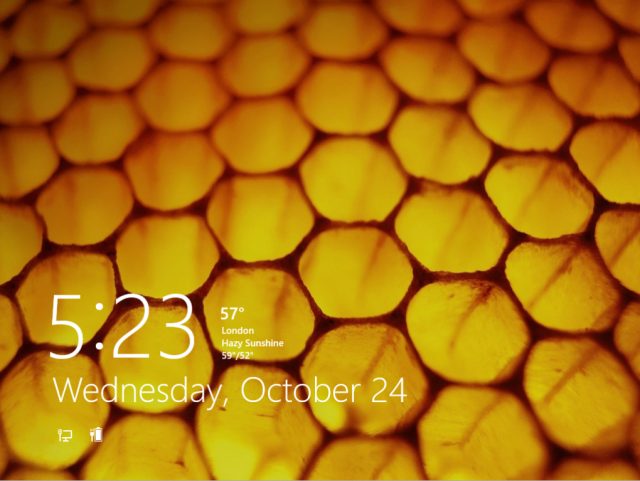
Windows installation has been a pretty painless process for many years now. Long gone are the DOS-based installations of Windows 2000 and Windows XP, instead, the installation is a fully graphical process. The Windows 8 installer, however, is even easier and faster than before. An upgrade install can be done in just under half an hour, while a fresh install from DVD takes barely over ten minutes. After installation, t he user will be greeted with a drastically revamped login screen:
 o
o


Microsoft released two main versions of their newest operating system: Windows 8 and Windows 8 RT. The RT edition is designed for ARM tablets, and is consequently targeted at a more niche market. I'll be looking at the standard Window 8, which is aimed at desktops, laptops, and x86-based tablets. To start off with, I'll look at the Windows 8 system requirements:
Windows installation has been a pretty painless process for many years now. Long gone are the DOS-based installations of Windows 2000 and Windows XP, instead, the installation is a fully graphical process. The Windows 8 installer, however, is even easier and faster than before. An upgrade install can be done in just under half an hour, while a fresh install from DVD takes barely over ten minutes. After installation, t he user will be greeted with a drastically revamped login screen:
 o
o
Upon first login, the user is shown a brief introduction tutorial. This hints at the significant changes in the Windows 8 interface--a tutorial has not been included with Windows since XP was released back in 2001. Upon completing the tutorial, the user sees the major change in Windows 8: the Metro UI
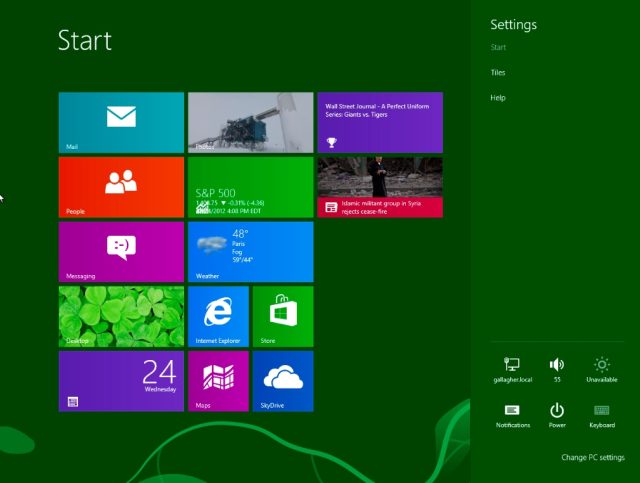
One of Microsoft's goals with Windows 8 was to create a single unified operating system that would work on "traditional" PCs (desktops and laptops) and tablets. The end result is Metro: a user interface with large, touch-friendly icons (some of which can be set to animate). Metro is the default interface that Windows 8 will boot to each time, although the "classic" desktop is retained, with a few changes:
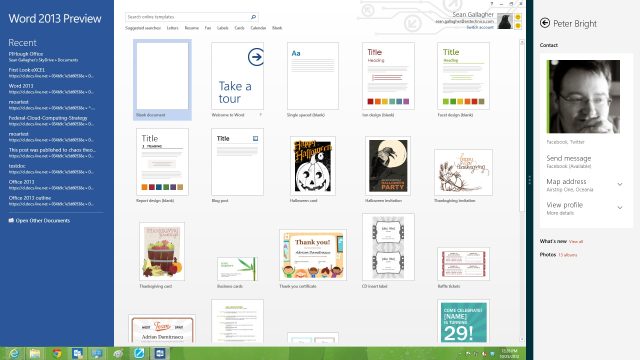
Ignoring user complaints, Microsoft has completely torn out the start menu. I personally believe that this was a terrible choice--even if the start menu came disabled by default, it should have been left as an option. The Windows 8 default theme is also boxier than in any version since Windows 2000--part of Microsoft's attempts to give Windows a visual overhaul.
Perhaps the most pressing question about Window 8 is how does it perform? While the new interface may be frightening, many people can be won over by performance numbers that show a convincing boost. Fortunately, Window 8 is generally as fast as or faster than Windows 7:
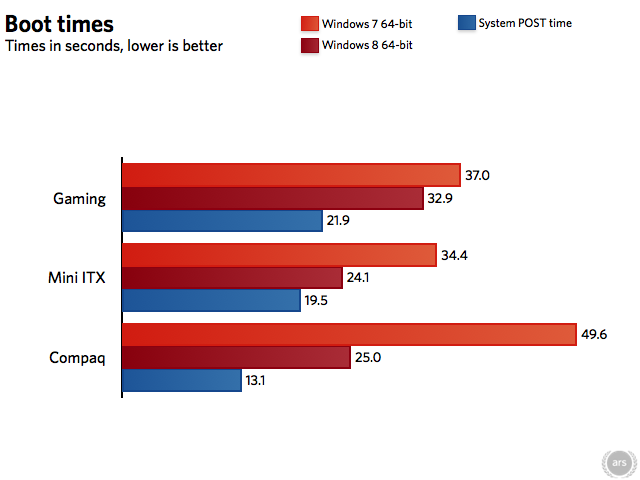

Will I be buying Windows 8? No. I see the new interface as too much of a disruption, and I'm going to be sticking with the Windows 7 interface I love dearly. However, Microsoft would clearly like Windows 8 to be the future. Whether or not it catches on will have an enormous impact on the manner in which we use computers for work and play.
Wednesday, October 10, 2012
5G Research Commencing
 The past year to year and a half has seem the mass adoption of 4G cellular phones as the primary choice of consumers. Practically every smartphone sold today supports 4G, and shipments of smartphones continue to soar (rising by 32% in Q2 2012). At the same time, all of the major US cellphone companies are expanding their 4G coverage, reaching a wide audience than ever before. You might think that with 4G only recently widely adopted, it would be too early to start thinking about the next great thing. You'd be wrong; according to Professor Tafozolli at the University of Surrey, ""4G for us is old hat. We started working on 4G 10 years ago." What this means is that while consumers are enjoying fast 4G service, researchers are moving ahead to the next great thing: 5G. As he explains, "mobile data traffic is soaring". Tafozolli says that his goals for 5G is that is it considerably faster than 4G (data traffic doubles every two years, but 4G can't keep up with that) while ultimately being more power-efficient. He says that 5G will be widely in place by 2020. This sounds like quite the challenge, but the improvements that we've seen over the past eight years are similarly phenomenal. Wikipedia mentions that other key features will be full use of IPv6 and support for connectivity across multiple wireless access technologies simultaneously.
 It's a refreshing sight to see innovation continue to march forward. Given the patent wars that are increasingly commonplace in the mobile market (which I believe suppress innovation), it's promising to see research universities do what they do best (now just wait for Apple to copy 5G and sue everyone else). Stay tuned for further developments!
Tuesday, October 2, 2012
The Crusade against Piracy
 This year has seen a remarkably intense crusade against online piracy. Governments and corporations around the world claim that piracy causes billions of dollars of damages in lost revenues, despite studies showing that piracy doesn't have a negative economic impact. Early this year, the United States Congress tried to pass SOPA and PIPA, two anti-piracy measures. Support for these collapsed in the face of mass protests, however, so they never came into effect. Furthermore, in January, the United States government, working with New Zealand authorities, oversaw the seizure of MegaUpload, a popular file-sharing site that critics said was designed to further piracy. Kim Dotcom, the owner of the site, was arrested and millions of dollars in property were confiscated. MegaUpload has shown recent signs of coming back, but there's still no certainty when or even if it will. In August, American and Ukrainian authorities brought down Demonoid, a popular BitTorrent site. More recently, there have been vague signs of life, but little progress towards a revival.
More recently, The Pirate Bay, which champions itself as "The Galaxy's Most Resilient BitTorrent site" also went offline. This is not the first time, in 2006 Swedish Authorities raided TPB, causing it to go offline for three days. This raid was described as "highly unsuccessful", with the Pirate Bay coming back online more popular than ever. Once again, the web host of The Pirate Bay, PRQ (which describes itself as a "no-questions-asked host") has been raided and the site has gone down. Will this be the end of TPB? Doubtful. The Pirate Bay has shown a remarkable ability to adapt and thrive, even in the face of adversity.
The War on Piracy has not just been confined to the United States and other countries it has succeeded in bullying. The Philippines recently passed the Cybercrime Prevention Act, a remarkably vague rule that criminalizes, among other things, piracy and pornography. A few weeks back, a new French anti-piracy law claimed its first victim, a man who has been convicted of failing to secure his internet connection.
 What does the future hold? I think we can safely say that there will be more serious laws designed to stamp out online piracy, and further seizures of file sharing websites. I also believe, however, that The Pirate Bay will be back, and that pirates will find new and innovative ways to get around ever fiercer restrictions. There's one thing of which we can be certain: the battle will be long and hard, and there's no telling yet which way it will go. Government can try to stamp out internet activists, but it won't be easy.
Wednesday, September 12, 2012
Will the desktop PC remain viable?
The past few years have seem a rather remarkable transformation of the personal computer industry. The once-venerable desktop PC has faced increasing challenges in viability, first from laptop PCs and then netbooks. Starting last year, however, even netbooks had a new challenger, with tablet shipments overtaking netbook shipments for the first time in Q2 2011. Since the introduction of the Apple iPad and competing Android tablets, the tablet market has grown at an astonishingly fast rate, up by 75% this year alone. The sales of traditional Windows PCs, however, have been lackluster. Part of this can be attributed to the imminent release of Windows 8; PC sales typically drop before the release of a new version of Windows. The end result, however, is that PC sales could possibly be headed for the worst second half ever.
To PC manufacturers, this trend is clearly not a desirable one. While Apple is able to make a 30% profit margin on iPads, other manufactures are not able to command such high prices. Reports are that Google might even by losing money on the sale of the Nexus 7 tablet. Consequently, many companies are looking to revitalize the sinking PC market and bring back the greater profit margins of before.
 Enter a new desktop PC being developed by Intel. Coming in at just over four inches square, it's considerably smaller than even the Mac Mini, which is often used as the "gold standard" of small desktop PCs. Compared to nettops (basically a netbook converted into a desktop), it's considerably smaller, and, it will deliver a considerably better user experience. With a Core i3, support for 16GB of RAM, and coming standard with a solid state hard drive, Intel's new $400 micro-PC has a lot to recommend itself. Will it be enough to turn around a sinking industry? That remains to be seen, but it certainly has a chance.

To PC manufacturers, this trend is clearly not a desirable one. While Apple is able to make a 30% profit margin on iPads, other manufactures are not able to command such high prices. Reports are that Google might even by losing money on the sale of the Nexus 7 tablet. Consequently, many companies are looking to revitalize the sinking PC market and bring back the greater profit margins of before.
 Enter a new desktop PC being developed by Intel. Coming in at just over four inches square, it's considerably smaller than even the Mac Mini, which is often used as the "gold standard" of small desktop PCs. Compared to nettops (basically a netbook converted into a desktop), it's considerably smaller, and, it will deliver a considerably better user experience. With a Core i3, support for 16GB of RAM, and coming standard with a solid state hard drive, Intel's new $400 micro-PC has a lot to recommend itself. Will it be enough to turn around a sinking industry? That remains to be seen, but it certainly has a chance.
Monday, August 27, 2012
This past week has seen the improbable nearly-complete victory of Apple Computer over Samsung Electronics. A patent battle between Apple and Samsung (among other Android phone manufacturers, including Motorola Mobility, now a subsidiary of Google) has long been in the works. When the Apple iPhone was released in June 2007, it was undoubtedly the best smartphone available, borrowing features from earlier platforms (as well as academia) to create an unrivaled experience. Since then, however, Android has hit the scene, and quickly taking the #1 spot in smartphone operating systems, with over twice the market share of iOS. Apple, unsurprisingly, has been less than entirely thrilled with this: with only one new phone a year it has been unable to compete on the hardware side (or, increasingly, software side, as the Google Market gets more and more apps) and has resorted to legal battles.
In 1996, Steve Jobs famously said "We have always been shameless about stealing great ideas." Jobs uttered this quote at a time when Apple's market share had plummeted to an all-time low, and he was desperately hoping to get his company back on a track towards success.
Despite Jobs' endorsement of the theft of intellectual property, he has been unwilling to let his competitors engage in the same sort of business practices that he did. Apple managed to extort a swipe-to-unlock patent despite prior art, and, more remarkably, a prior patent by Swedish phone manufacturer Neonode. In a similar vein, Apple has also managed to patent multi-touch features that had been developed by academia two and a half decades prior.

Not content to steal innovations from other companies, Steve Jobs declared that he was willing to go "thermonuclear war" on Android because it was a "stolen product". Consequently, the past few years have seem a nearly-continuous patent battle between Apple and the largest Android phone manufacturers (Samsung, Motorola, and HTC). Both sides have scored some relatively small victories in the courts, but it is just recently that we see a victory of unprecedented scale. A US District court has recently determined that Samsung "slavishly copied" Apple's technology (Apple's words). The damages? Samsung is to pay over a billion dollars in fines, and could likely see a great many of its products (including its Galaxy smartphones and tablets) banned in the United States, resulting in billions of dollars in lost sales.
Why does this matter? For one, should Samsung's products be banned, it would considerably narrow the field of smartphones. Samsung has produced some of the most feature-filled phones available, and the loss of that option is a major blow to consumers. Furthermore, and perhaps more importantly, the loss of Samsung as a viable competitor in the United States could lead to the further rise of smartphone prices. Apple's products are already famously expensive. Perhaps more damning, however, the Courts have effectively legitimized the patenting of already-existing technologies and frivolous lawsuits. As companies have to devote more and more money to legal battles, consumers are likely to charged more. Furthermore, many companies may be afraid of stepping on the toes of others, and will consequently be less willing to pursue new technologies.
Regardless of whether you prefer iPhones or Android phones, you should recognize the damage done by this lawsuit.
In 1996, Steve Jobs famously said "We have always been shameless about stealing great ideas." Jobs uttered this quote at a time when Apple's market share had plummeted to an all-time low, and he was desperately hoping to get his company back on a track towards success.
Despite Jobs' endorsement of the theft of intellectual property, he has been unwilling to let his competitors engage in the same sort of business practices that he did. Apple managed to extort a swipe-to-unlock patent despite prior art, and, more remarkably, a prior patent by Swedish phone manufacturer Neonode. In a similar vein, Apple has also managed to patent multi-touch features that had been developed by academia two and a half decades prior.
Not content to steal innovations from other companies, Steve Jobs declared that he was willing to go "thermonuclear war" on Android because it was a "stolen product". Consequently, the past few years have seem a nearly-continuous patent battle between Apple and the largest Android phone manufacturers (Samsung, Motorola, and HTC). Both sides have scored some relatively small victories in the courts, but it is just recently that we see a victory of unprecedented scale. A US District court has recently determined that Samsung "slavishly copied" Apple's technology (Apple's words). The damages? Samsung is to pay over a billion dollars in fines, and could likely see a great many of its products (including its Galaxy smartphones and tablets) banned in the United States, resulting in billions of dollars in lost sales.
Why does this matter? For one, should Samsung's products be banned, it would considerably narrow the field of smartphones. Samsung has produced some of the most feature-filled phones available, and the loss of that option is a major blow to consumers. Furthermore, and perhaps more importantly, the loss of Samsung as a viable competitor in the United States could lead to the further rise of smartphone prices. Apple's products are already famously expensive. Perhaps more damning, however, the Courts have effectively legitimized the patenting of already-existing technologies and frivolous lawsuits. As companies have to devote more and more money to legal battles, consumers are likely to charged more. Furthermore, many companies may be afraid of stepping on the toes of others, and will consequently be less willing to pursue new technologies.
Regardless of whether you prefer iPhones or Android phones, you should recognize the damage done by this lawsuit.
Subscribe to:
Comments (Atom)