The Supreme Court is now considering a case with profound implications. In Kirtsaeng v. Wiley, the argument is what restrictions there will be on the "first sale" doctrine--which is the basis of the right to sell or lend copyrighted items that we own. This doctrine is monumental, and it is what allows sites like Ebay and Craigslist to operate. It makes sure that copyright holders can't deny you the ability to sell things like CDs and electronic devices that you've legally purchased.
How did this case come up? Well, many students have recognized that textbooks are cheaper abroad than they are here in the United States. While the international editions may be more cheaply made, the price difference can easily be half the cost of the work (or more). Consequently, many international students studying in the US choose to purchase their books in their home countries rather than here. This simple tactic helped make college a more affordable adventure. Some students realized that they could purchase textbooks in mass in other countries, bring them to the United States, and resell them. This, in fact, is precisely what spawned Kirtsaeng v. Wiley. Thai student Supap Kirtsaeng established a business where he purchased textbooks in his native country, brought them to the United States, and then resold them at a profit. Wiley, the publisher of the books, alleges that this violates copyright law. Publishers argue that different pricing schemes are vital to their success, while Kirtsaeng argues that he legally purchased the books and has done nothing wrong. Kirtsaeng has attracted the support of Ebay, Goodwill, and even libraries. Wiley, meanwhile, has attracted the support of other publishers, software companies, and the entertainment industry.
In essence, publishers are trying to get every sale classified as a mere license agreement; in order to transfer the item to a new person, there would have to be a new license agreement with the manufacturer. The implications of this are horrendous: what you purchase, you don't actually own. That movie you bought? It's actually just licensed from the studios, for your use only. That textbook? Licensed. Should Wiley win, it's entirely probable that copyright holders would impose stringent restrictions on the resale of their works.
It's shit like this that makes The Pirate Bay appealing. I hate supporting a company that behaves this arrogantly.
Tuesday, October 30, 2012

Friday, October 26, 2012
Windows 8 is Released
Today, Microsoft proudly announced the release of the latest version of their popular Windows operating system -- Windows 8. Windows 8 marks the greatest overhaul to the Windows interface since 1995. Were the changes introduced longer overdue, or did Microsoft fix something that wasn't broken?
Microsoft released two main versions of their newest operating system: Windows 8 and Windows 8 RT. The RT edition is designed for ARM tablets, and is consequently targeted at a more niche market. I'll be looking at the standard Window 8, which is aimed at desktops, laptops, and x86-based tablets. To start off with, I'll look at the Windows 8 system requirements:
 These system requirements are surprisingly not drastically changed from Windows 7. The hard drive capacity suggestion is higher, but otherwise the requirements are unchanged.
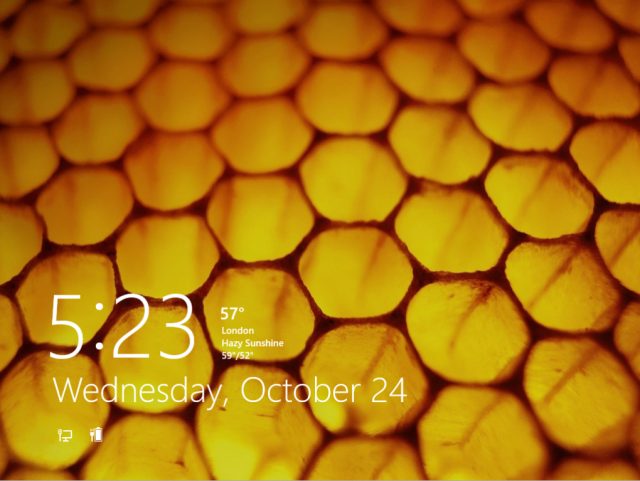
Windows installation has been a pretty painless process for many years now. Long gone are the DOS-based installations of Windows 2000 and Windows XP, instead, the installation is a fully graphical process. The Windows 8 installer, however, is even easier and faster than before. An upgrade install can be done in just under half an hour, while a fresh install from DVD takes barely over ten minutes. After installation, t he user will be greeted with a drastically revamped login screen:
 o
o


Microsoft released two main versions of their newest operating system: Windows 8 and Windows 8 RT. The RT edition is designed for ARM tablets, and is consequently targeted at a more niche market. I'll be looking at the standard Window 8, which is aimed at desktops, laptops, and x86-based tablets. To start off with, I'll look at the Windows 8 system requirements:
Windows installation has been a pretty painless process for many years now. Long gone are the DOS-based installations of Windows 2000 and Windows XP, instead, the installation is a fully graphical process. The Windows 8 installer, however, is even easier and faster than before. An upgrade install can be done in just under half an hour, while a fresh install from DVD takes barely over ten minutes. After installation, t he user will be greeted with a drastically revamped login screen:
 o
o
Upon first login, the user is shown a brief introduction tutorial. This hints at the significant changes in the Windows 8 interface--a tutorial has not been included with Windows since XP was released back in 2001. Upon completing the tutorial, the user sees the major change in Windows 8: the Metro UI
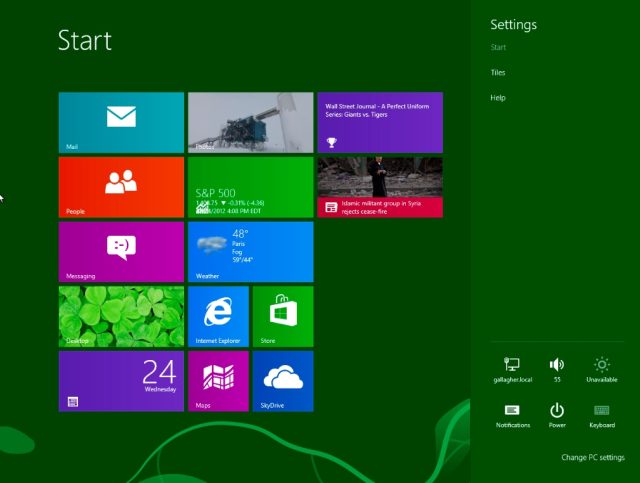
One of Microsoft's goals with Windows 8 was to create a single unified operating system that would work on "traditional" PCs (desktops and laptops) and tablets. The end result is Metro: a user interface with large, touch-friendly icons (some of which can be set to animate). Metro is the default interface that Windows 8 will boot to each time, although the "classic" desktop is retained, with a few changes:
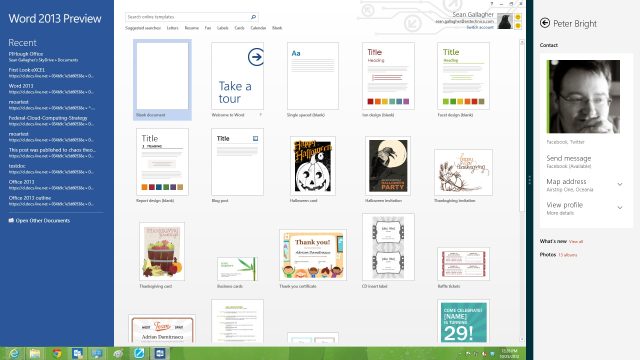
Ignoring user complaints, Microsoft has completely torn out the start menu. I personally believe that this was a terrible choice--even if the start menu came disabled by default, it should have been left as an option. The Windows 8 default theme is also boxier than in any version since Windows 2000--part of Microsoft's attempts to give Windows a visual overhaul.
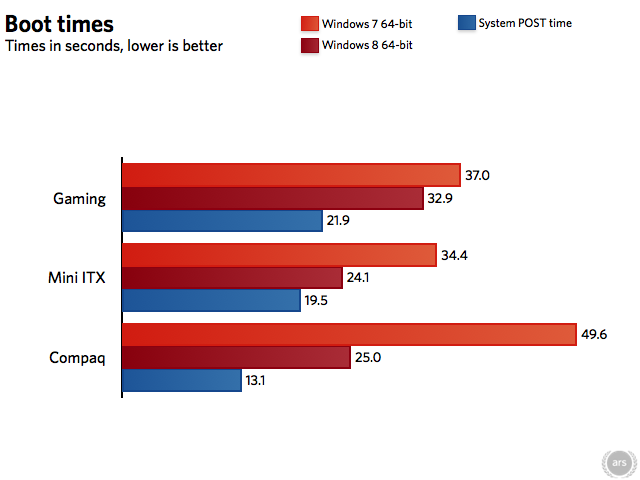
Perhaps the most pressing question about Window 8 is how does it perform? While the new interface may be frightening, many people can be won over by performance numbers that show a convincing boost. Fortunately, Window 8 is generally as fast as or faster than Windows 7:

Will I be buying Windows 8? No. I see the new interface as too much of a disruption, and I'm going to be sticking with the Windows 7 interface I love dearly. However, Microsoft would clearly like Windows 8 to be the future. Whether or not it catches on will have an enormous impact on the manner in which we use computers for work and play.
Wednesday, October 10, 2012
5G Research Commencing
 The past year to year and a half has seem the mass adoption of 4G cellular phones as the primary choice of consumers. Practically every smartphone sold today supports 4G, and shipments of smartphones continue to soar (rising by 32% in Q2 2012). At the same time, all of the major US cellphone companies are expanding their 4G coverage, reaching a wide audience than ever before. You might think that with 4G only recently widely adopted, it would be too early to start thinking about the next great thing. You'd be wrong; according to Professor Tafozolli at the University of Surrey, ""4G for us is old hat. We started working on 4G 10 years ago." What this means is that while consumers are enjoying fast 4G service, researchers are moving ahead to the next great thing: 5G. As he explains, "mobile data traffic is soaring". Tafozolli says that his goals for 5G is that is it considerably faster than 4G (data traffic doubles every two years, but 4G can't keep up with that) while ultimately being more power-efficient. He says that 5G will be widely in place by 2020. This sounds like quite the challenge, but the improvements that we've seen over the past eight years are similarly phenomenal. Wikipedia mentions that other key features will be full use of IPv6 and support for connectivity across multiple wireless access technologies simultaneously.
 It's a refreshing sight to see innovation continue to march forward. Given the patent wars that are increasingly commonplace in the mobile market (which I believe suppress innovation), it's promising to see research universities do what they do best (now just wait for Apple to copy 5G and sue everyone else). Stay tuned for further developments!
Tuesday, October 2, 2012
The Crusade against Piracy
 This year has seen a remarkably intense crusade against online piracy. Governments and corporations around the world claim that piracy causes billions of dollars of damages in lost revenues, despite studies showing that piracy doesn't have a negative economic impact. Early this year, the United States Congress tried to pass SOPA and PIPA, two anti-piracy measures. Support for these collapsed in the face of mass protests, however, so they never came into effect. Furthermore, in January, the United States government, working with New Zealand authorities, oversaw the seizure of MegaUpload, a popular file-sharing site that critics said was designed to further piracy. Kim Dotcom, the owner of the site, was arrested and millions of dollars in property were confiscated. MegaUpload has shown recent signs of coming back, but there's still no certainty when or even if it will. In August, American and Ukrainian authorities brought down Demonoid, a popular BitTorrent site. More recently, there have been vague signs of life, but little progress towards a revival.
More recently, The Pirate Bay, which champions itself as "The Galaxy's Most Resilient BitTorrent site" also went offline. This is not the first time, in 2006 Swedish Authorities raided TPB, causing it to go offline for three days. This raid was described as "highly unsuccessful", with the Pirate Bay coming back online more popular than ever. Once again, the web host of The Pirate Bay, PRQ (which describes itself as a "no-questions-asked host") has been raided and the site has gone down. Will this be the end of TPB? Doubtful. The Pirate Bay has shown a remarkable ability to adapt and thrive, even in the face of adversity.
The War on Piracy has not just been confined to the United States and other countries it has succeeded in bullying. The Philippines recently passed the Cybercrime Prevention Act, a remarkably vague rule that criminalizes, among other things, piracy and pornography. A few weeks back, a new French anti-piracy law claimed its first victim, a man who has been convicted of failing to secure his internet connection.
 What does the future hold? I think we can safely say that there will be more serious laws designed to stamp out online piracy, and further seizures of file sharing websites. I also believe, however, that The Pirate Bay will be back, and that pirates will find new and innovative ways to get around ever fiercer restrictions. There's one thing of which we can be certain: the battle will be long and hard, and there's no telling yet which way it will go. Government can try to stamp out internet activists, but it won't be easy.
Subscribe to:
Comments (Atom)